How to Do a Store Walk: The District Manager's Playbook
The practical four-stage playbook for district and regional managers running effective store walks across multi-location retail — preparation, walk pattern, debrief, and follow-up.

There’s a moment about two weeks into being a new district manager when the romance wears off. You’ve been promoted. You have your stores. You walk into the first one with your clipboard and… now what? You stand near the entrance, glance at the merchandising, and realize you have no idea what you’re actually supposed to be doing for the next 90 minutes.
This post is the playbook that experienced district managers carry in their heads. It’s not glamorous. It’s a structure that turns a vague “store visit” into a repeatable, measurable thing that actually moves performance.
What a store walk really is (and the three versions DMs confuse)
A store walk is a structured, scheduled visit to one of your locations with three explicit goals: measure, coach, and fix. That’s it. Everything else is noise.
DMs new to the role tend to confuse a store walk with one of three other things:
- A drop-in visit — friendly, social, low-stakes. Fine in moderation but not the same thing.
- An ops fire-drill — you got a call, something is broken, you’re there to triage. Reactive.
- A field training session — you brought a corporate ops person, you’re showing them stores. Different agenda.
A real store walk is proactive, structured, and produces actions. If you leave a store with no follow-up items, you didn’t do a walk — you did a visit.
The 4-stage framework
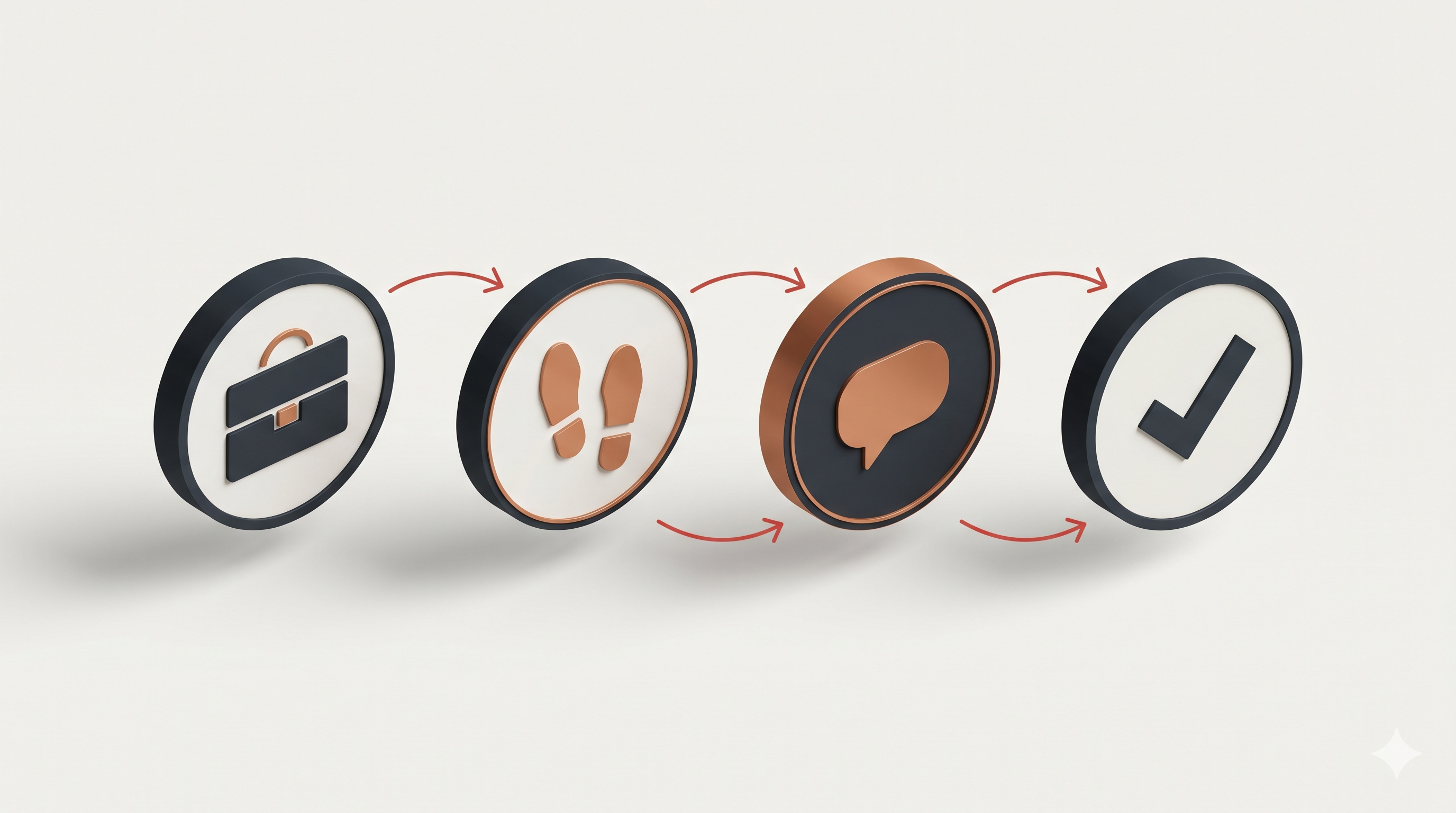
| Stage | Time | Purpose |
|---|---|---|
| 1. Prep | 15-20 minutes (before arrival) | Know what you’re walking into |
| 2. Walk | 60-90 minutes (in store) | Measure against standard |
| 3. Debrief | 20-30 minutes (in store, before leaving) | Coach and align |
| 4. Follow-Up | 5-7 days (after) | Verify fixes happened |
The math: a single store walk is roughly a half-day commitment, including travel. New DMs often try to compress this into 90 minutes total. It doesn’t work — you skip the prep, you rush the debrief, and you never follow up. The walk becomes performative.
Stage 1: Pre-visit preparation (15-20 minutes)
The walk starts the night before, not when you pull into the parking lot. The job here is to know what you’re walking into so you can spot the gap between what should be true and what is true.
Pull the data first:
- Last 7 days of sales vs. plan, vs. last year, vs. district average
- Last audit score and any open action items from previous walks
- Staffing: who’s scheduled today, any recent terminations or new hires
- Inventory anomalies: shrink alerts, recent transfers, any open receiving discrepancies
- Customer complaints in the last 30 days
- Any ongoing ops tickets (HVAC, pest, repair)
Set 3 specific things to look for. Don’t go in trying to “see everything.” Pick three based on what the data flags. Examples: “Why is conversion down 4% week-over-week?” “How is the new endcap actually executed?” “Is the new closer following the close-out checklist?”
Decide whether to announce yourself. Surprise visits catch real conditions but burn trust. Announced visits get the store at its best but tell you nothing about Tuesday morning. Mix it up — roughly 60% announced, 40% surprise is a healthy blend for an established DM.
Stage 2: The 60-minute walk pattern
Walk the store the way a customer would, then the way an inspector would, then the way an owner would. Three passes, each with a different lens.
Pass 1: The customer pass (15 minutes)
Park in the customer lot. Walk in the front door. Don’t go say hi to the manager yet. You want to see what a first-time customer sees.
Notice:
- How long until anyone acknowledges you?
- How does the entry feel — clean, cluttered, on-brand?
- Are the front-of-store displays current or stale?
- If you ask a staff member a basic question, can they answer?
Carry your phone, take photos as a customer would. These photos go into the audit later.
Pass 2: The inspector pass (30-40 minutes)
Now do the formal walk. Use a structured 47-item audit checklist and go zone by zone — exterior, entry, merchandising, cleanliness, inventory, pricing/signage, staff, loss prevention, back of house. Score every item. Take photos of every fail.
This is the boring middle of the walk. Resist the urge to skip the back of house “because it’s always fine.” The single best leading indicator of a store going off the rails is what the stockroom looks like.
Pass 3: The owner pass (15 minutes)
Final pass: walk like you own the place and your money is on the line. This is where you ask questions the inspector can’t:
- Why are we carrying so much of [SKU]? Is it actually selling?
- Why is staffing structured this way at this hour? Is the labor model right for this store’s traffic pattern?
- What would I cut if revenue dropped 20%?
- What would I double down on if I had a 20% bigger budget?
The owner pass produces strategic notes, not action items. They go in your DM journal for trend-spotting across stores, not into a corrective-action ticket.
Stage 3: The debrief conversation (20-30 minutes, with the store manager, before leaving)
This is the stage most DMs do worst. They either skip it (“I’ll send notes later”), or they turn it into a scolding session that destroys trust.
The right structure is short, three parts:
1. Wins (3-5 minutes)
Open with what’s working. Specific: “Your endcap on the new product launch is the cleanest execution in the district.” Generic praise (“you’re doing great”) is worse than no praise at all.
2. Findings (10-15 minutes)
Walk through the audit results — together, looking at the photos. The key reframe: it’s not your audit, it’s the brand standard’s audit. You’re both on the same side of the table evaluating the store against an external standard.
For each fail:
- Show the photo
- Ask “what happened here?” before assigning blame
- Listen to the answer (sometimes there’s context you didn’t know — supplier shipped late, two callouts that morning, fixture broken since yesterday)
- Decide together: is this a one-time thing, a process gap, or a training gap?
3. Commitments (5-10 minutes)
Pick the three most important things to fix in the next 7 days. Not 17 things. Three. With dates and owners.
A good rule: don’t leave the store until the manager has the action items written down with their own hand. If you carry the action list out of the store, the manager treats it as your problem. If they wrote it, it’s theirs.
Stage 4: Follow-up that actually happens (5-7 days later)
Most teams leak 80% of their store-walk value here. The walk happened, the debrief happened, the action items got assigned, and then… nobody checked back.
The follow-up loop, minimum:
- Day +1: Send a short summary to the manager (and copy your regional). One paragraph: top 3 wins, top 3 actions, dates. This is the official record.
- Day +3: Quick check-in text. “How’s the back-of-house reorganization going?” Just one item, just a nudge.
- Day +7: Verify completion — either via a photo the manager sends you, or a brief return visit. Close the loop.
If the action wasn’t completed, that’s its own data point. Three uncompleted actions in a row from the same store is a manager problem, not a process problem. That’s a different conversation.
The teams that do this well don’t have to walk each store as often, because the follow-up loop is itself a kind of audit. Stores know the action list will be checked, so they fix things proactively.
Coverage model: how often to walk each store
A common new-DM mistake is walking each store the same amount. That wastes your time on top performers and underserves the stores that need you most.
| Store performance | Walk cadence |
|---|---|
| New location, first 90 days | Weekly |
| Bottom quartile by audit or sales | Bi-weekly |
| Average performers | Monthly |
| Top quartile, established | Quarterly + ad-hoc |
| Acquired or recently remodeled | Weekly for first 60 days |
| Manager change | Weekly for first 30 days post-change |
Audit cadence is a budget. Spend it where it moves performance.
Red flags that experienced DMs notice in 30 seconds
You’ll learn these in your first six months. Listed in case you want a head start:
- The trash cans by the entrance are full. (Means nobody’s walking the floor.)
- The fitting room mirrors are smudged. (Same.)
- The break room is messier than the sales floor. (Means the manager works the floor but doesn’t check back of house.)
- The schedule on the wall is two weeks old. (Means the manager isn’t using their own ops tools.)
- Half-eaten food at a cash wrap. (Means coverage is unreliable.)
- An open box of stock visible from the customer side of an aisle. (Means tasking discipline is broken.)
- The bathroom log isn’t initialed. (Almost universally correlates with audit failure.)
Conversely, green flags:
- Faces forward, even on bottom shelves
- Endcaps swept and dusted (most stores ignore endcap maintenance)
- Stockroom organized by department, not by truck arrival
- Manager knows top-3 SKUs by current sales rank without checking their phone
Common mistakes new district managers make
-
Walking too much. A new DM walks every store every week trying to be visible. By month three, they’re exhausted, the audits are sloppy, and the action items are piling up unverified. Better: walk fewer stores, more thoroughly, with real follow-up.
-
Treating the walk as a relationship visit. Friendly is fine. Vague is not. Stores need to know the walk has structure — that’s how they know to take it seriously.
-
Assigning too many action items. If you leave 14 actions, none of them get done. Three is the magic number. The other 11 issues either get rolled into a process change at HQ, or they get re-flagged on the next walk.
-
Never returning to a fail. If you flagged “back stock disorganized” in February and you’re still flagging it in May, you’ve trained the manager that you don’t actually verify. Verify the fix happened or it didn’t happen.
-
Coaching by criticism. Audits feel adversarial. The manager and you are on the same side — against an external brand standard. Frame every conversation that way.
From clipboard to system: when to graduate
The clipboard works for a year. By year two, you’re a DM with 12 stores and you can’t remember which one had the bathroom-log issue, you have 400 photos in your camera roll with no organization, and the action items live in three different texts.
That’s the moment to move to software — whether that’s StoreAudit or one of the other audit platforms we compared. The software doesn’t replace the playbook above. It just makes the playbook actually work at scale.
The walk is still a walk. The debrief is still a debrief. But now the action items live somewhere everyone can see, the photos are attached to the right line items, and the trend across all 12 of your stores is visible in one chart instead of in your head.
Related reading: